

Seawater temperatures reach maximum values over the last 16 years
This year the Hydrographic Institute recorded an increase in sea temperature to the surface, along the coast of the Algarve and the Vicentina Coast, during July and August, compared to previous years.
ALGARVE
The high temperatures of sea water recorded this year on the beaches of the Algarve were due to the unusual persistence of the lift wind (which blows from the east quadrant), during the months of July and August. The action of this wind on the surface of the sea caused, in addition to a south-east sea agitation with a significant height of more than 1 m, the dragging of the masses of water to the surface of the sea to the coast, which allowed its heating over the last 2 months.
This result was recorded by the integrated ocean observation system of the Hydrographic Institute (MONIZEE network), whose oceanographic buoys fused off mainland Portugal measure the intensity and direction of the wind to the surface of the sea, the temperature of air and water, as well as the maritime agitation and surface currents. Thus, the buoys found off the Algarve this year had an average temperature of 22.3°C in July and 23.9°C in July. C in August. These values correspond to an increase of 2°C and 2.7°C relative to their averages over the last 16 years (2000-2015). The maximum recorded this year was 26.5°C on 28 July, corresponding to a value very close to the historical maximum recorded in 2010 (26.6°C). It should be noted that by the beaches, the permanence of these bodies of water on smaller depths allows for greater water heating, with higher temperatures.
COSTA VICENTINA
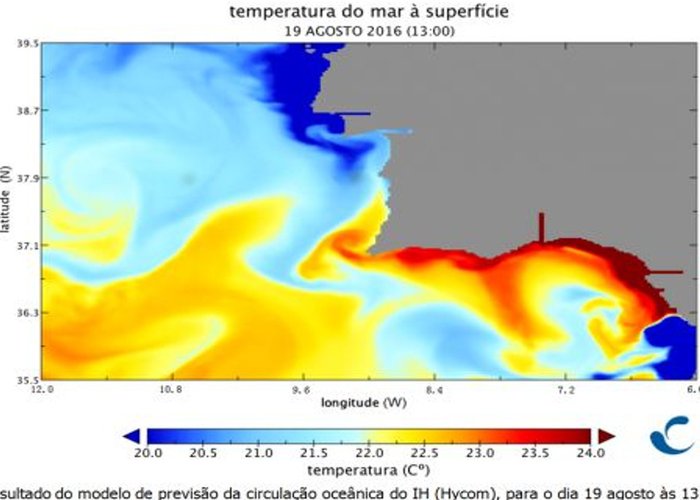
The high seawater temperatures that occurred in mid-August along the Vicentina coast originated in the Algarve, where the water masses warmed up during the months of July and August. However, the oceanographic process that transported these masses of water to Sines, Troy and even Sesimbra is not only due to the wind of uprising recorded in the Algarve, but to the conjugation of this episode with the absence of the northern (northwind) along the west coast of Portugal, which usually blows with intensity during this period of the year. After an intense period of nortada in July, resulting in an outcropping of cold water from the seabed that kept the temperature of the beaches of the Vicentina coast below 19oC, there was a change in this wind regime in August, with the reduction of its speed and its rotation to the Southwest quadrant. This process allowed the transport of warmer water, from the Algarve coast through a coastal current that surrounded the Cape of Sagres and reached the Vicentina coast, even reaching the Cape Espichel.
This ocean current was reproduced by the numerical model of the Hydrographic Institute, which, like the weather models, which anticipate the dynamics of the atmosphere, provides daily ocean circulation off mainland Portugal. This model is used operationally by the IH to support the missions of the Portuguese Navy and the National Maritime Authority. The results of this model are daily validated by the MONIZEE network and allow a detailed knowledge of the dynamics of the ocean off Portugal.
The MONIZEE observation network, which integrates an oceanographic buoy off Sines, recorded the passage of this warmer water stream between August 11 and 20. This episode led to an increase in the average temperature recorded by this buoy, reaching 19.7°C, about 1.6°C higher than the average of the last 16 years (2000-2015). This year there was even a historical maximum of 23.1°C, on 19 August, higher at about 1.5°C to the maximum previously recorded in August.
Seawater temperatures reach maximum values over the last 16 years
500 
2016-09-05