

Kick-off of the cooperation protocol between the Faculty of Fine Arts and the Hydrographic Institute
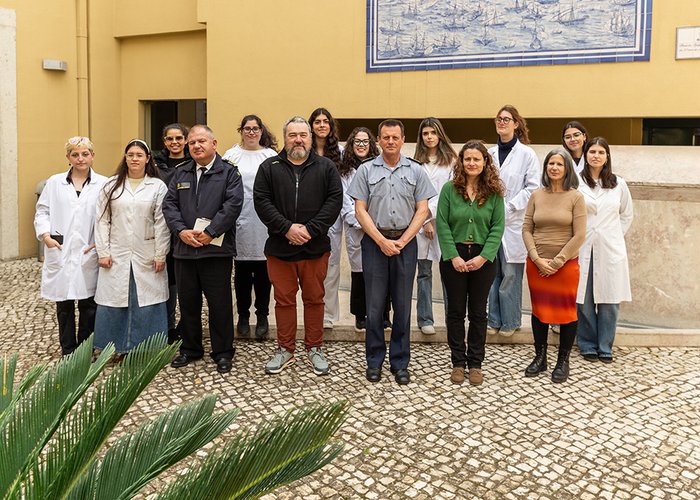
On 22 March, the first action under the Cooperation Protocol between the Hydrographic Institute (HI) and the Faculty of Fine Arts of the University of Lisbon (FBAUL) took place, signed in December 2023.
This action took place in workshop of Conservation and Restoration, carried out in the framework of the studies ofMaterials, Techniques and Diagnosis of Cultural Goods», with students from the Graduate and Master of the Art and Heritage Sciences Course. O workshop it was divided into two sessions under the guidance of the auxiliary teachers of the Department of Art and Heritage Sciences, Ana Bailão and Frederico Henriques.
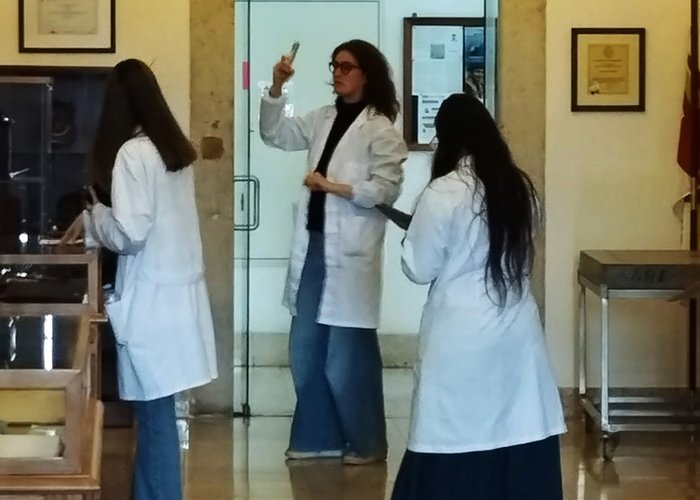
In the morning, based on a "Route of the insert heritage», produced by the IH Documentation and Culture Division, the students carried out an elementary screening of the physical and environmental conditions of the building of the old Convent of the Trinas, in the various spaces and compartments through which the collections of baroque tile and technical-scientific artifacts of the IH are distributed. Data on temperature, humidity and luminosity parameters were collected in order to draw up an evaluation report.
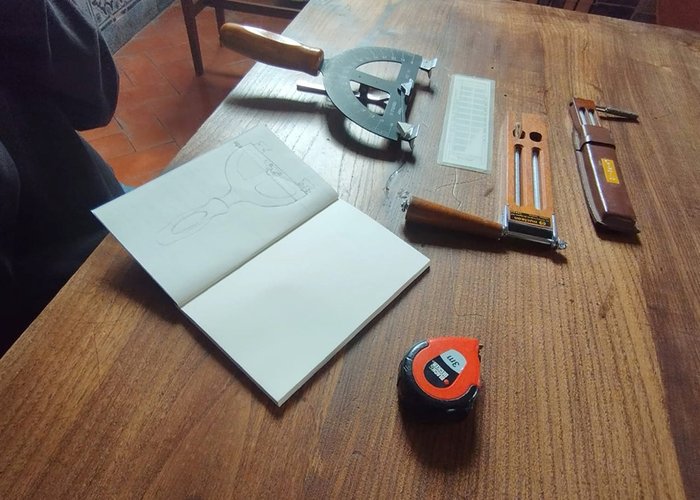
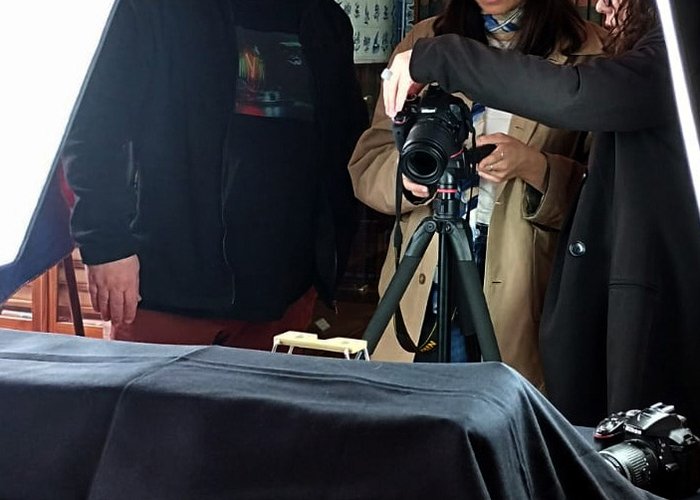
In the afternoon, with the collaboration of Professor Frederico Henriques, responsible for the Multimedia Laboratory, assisted by monitor Inês Simões, a mobile studio of drawing and photogrammetry was set up in the IH library. The work program consisted of drawing and documenting photographically a set of hydrography, navigation and cartographic design equipment belonging to the heritage of the Institute, selected by its formal and structural simplicity: pantograph compasses, stereoscopes, psychometers, clinometers, were some of the instruments adopted for analysis and graphic recording, preliminary operations to the construction of a particular information system for each object. The photogrammetric processing of the instruments was followed, necessary for subsequent treatment by a software modelling 3D.
The first workshop conservation and restoration also allowed the exchange of academic documentation on the identification of plastics, their typology and nomenclatures ("polymer identification diagram», among others), relevant information for the understanding and characterization of technological artifacts from the Sea Sciences, in which equipment is largely made up of plastic and composite materials (as well as metal and chemical alloys) whose identification and conservation is often difficult, if not impossible.
From this first day of cooperation between FBAUL and the IH, we expect an updated reflection on the conservation practices that can give rise to the renewal of knowledge, fundamentally to support the decision in the management of the mobile heritage, inserted and built from the headquarters of the IH and its physical conditions, and in particular with regard to the extensive collections of tiles of the XVIII century of the Institute. To this extent, it is already planned to carry out a second initiative with the Department of Art Sciences and Heritage of the FBA, this time, on the possibilities of specific interventions of conservation and restoration of tiles.
Kick-off of the cooperation protocol between the Faculty of Fine Arts and the Hydrographic Institute
Kick-off of the cooperation protocol between the Faculty of Fine Arts and the Hydrographic Institute
Kick-off of the cooperation protocol between the Faculty of Fine Arts and the Hydrographic Institute
Kick-off of the cooperation protocol between the Faculty of Fine Arts and the Hydrographic Institute
102 
2024-04-06