

IH finishes the hydrographic surveys of the Douro Navigable Way
The Douro Navigable Way (VND), about 210 km long, is one of the most important communication, transport and development routes in Portugal. Under the management of the Administration of the Ports of Douro, Leixões and Viana do Castelo, SA (APPL) has been promoted and encouraged the navigation of this Via, assuming the Hydrographic Institute (HI), through the (institutional cooperation agreement), a key role in the acquisition of bathimetric information and environmental data that will allow the development of studies and water maps, essential for the “Douro’s Inland Waterway 2020” project (http://www.diw2020.pt/) and, consequently, for strengthening the safety and management conditions of navigation.
The topographic and water-based information makes it possible to morphologically characterize the bottom of the river and is essential for the preparation of the other projects and studies, in particular those relating to the enlargement and/or deepening of some sections of the VND. The following works are highlighted:
Link to national geodetic reference systems, with the materialisation of local planimetric and altimetric networks, the coordination of support points, the achievement of geometric levelings and the installation of tidegraphs to observe water levels.
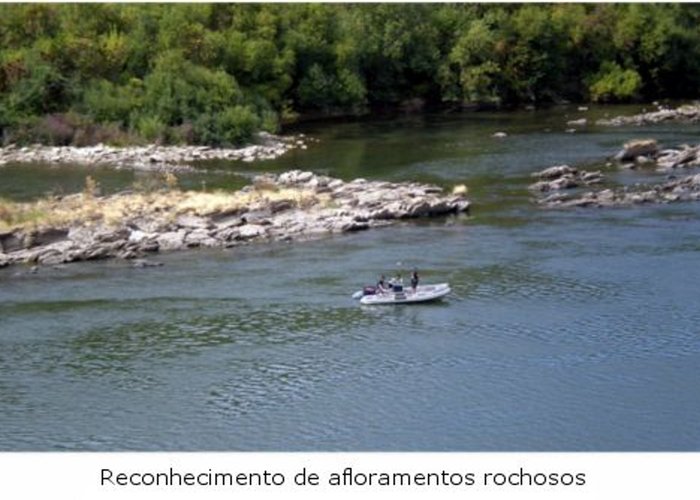
Topography of port structures, river access ramps, bridges, high-voltage poles, locks and surrounding area to dams, rocky outcrops, etc., and coordination of fixed and floating navigation aids. The topography of rocky outcrops should be highlighted in these works, which is essential to ensure the safety of survey vessels.
Hydrography:
With multi-beam probe, ensuring the requirements of the hydrographic surveys (LH) of special order on the navigation channel and in critical areas, important for local navigation and adjacent to the channel.
With interferometric probe, ensuring the requirements of LH order 1a, in areas where the acquisition of batimetric information was not considered critical for the safety of navigation.
With a simple beam probe, ensuring the requirements of LH of order 1b in areas of reduced depth, where the vessels were unable to operate safely.
IH finishes the hydrographic surveys of the Douro Navigable Way
157 
2016-09-20