

IH and FCUL sign cooperation protocol
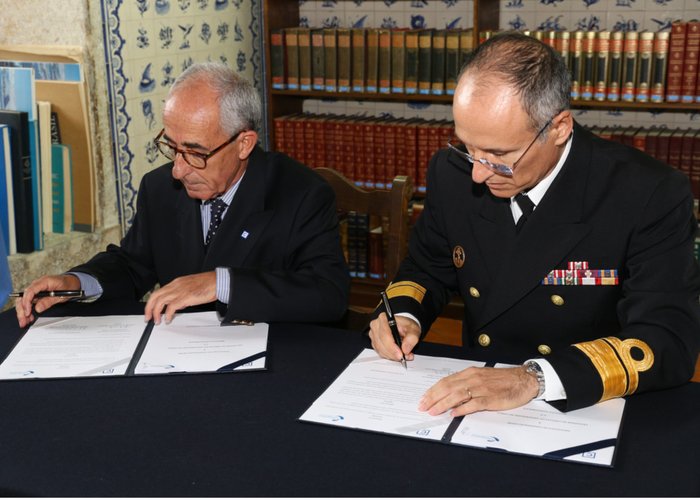
The Hydrographic Institute (IH) and the Faculty of Sciences of the University of Lisbon (FCUL), today, November 2, signed a cooperation protocol, in the academic and scientific field, in the area of the sciences of the sea.
This Protocol establishes the terms of cooperation between the FCUL and the IH, within the specific competences of the two institutions, with the aim of aligning their research strategies and agendas, optimizing the use of human resources, equipment and infrastructure, contributing to the training of qualified frameworks, taking advantage of the opportunities arising from the virtualities of the European Research Area and enhancing the national and international cooperation networks in which they are integrated.
In this act, signed by the IH the Director General, Rear Admiral António Manuel Coelho Cândido, and by the FCUL, the Director, Prof. José Artur Martinho Simões.
The Hydrographic Institute, as a body of the Navy and State Laboratory, has the fundamental mission of ensuring the research and technological development activities related to the sciences and techniques of the sea, particularly in the areas of hydrography, hydrographic mapping, navigation security, oceanography and defense of the marine environment.
The Hydrographic Institute has human, technological and knowledge of fundamental relevance for the pursuit of training and research activities in the field of marine sciences and participates in various research projects with other institutes and universities, national and foreign.
The Faculty of Sciences of the University of Lisbon conducts research and teaching in basic scientific fields in the fields of sea sciences, earth sciences and the environment, mathematical sciences and information, information and communication technologies, physical sciences and chemical sciences, thus providing scientific capacity and significant technological resources in areas of ongoing development and management of operational applications under the responsibility of the State laboratories, assuming a culture of cooperation and networking with the institutions of the national scientific and technological system, with a view to optimizing resources and effectiveness.

IH and FCUL sign cooperation protocol
IH and FCUL sign cooperation protocol
148 
2017-11-02