

Blue Ocean Expedition Discovers New Hydrothermal Field in the Azores
As part of the scientific expedition Blue Ocean, a new hydrothermal field was discovered in the Azores.
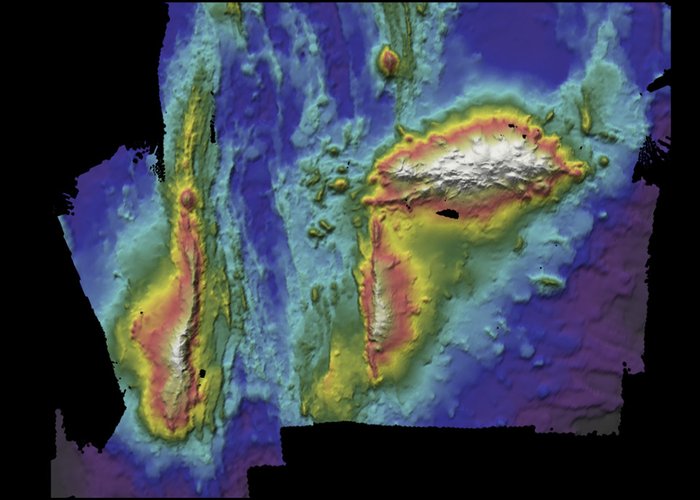
Located 570 meters deep, on the giant submarine hill, 60 miles from Faial Island, this new hydrothermal field is an area of high biological and mineral richness.
It is the first time that an expedition organized by a Portuguese institution, led by Portuguese scientists and using ships and national means locates a deep water hydrothermal field in our maritime territory.
The expedition is organized by the Blue Ocean Foundation in partnership with the Waitt Foundation and the National Geographic Pristine Seas, and in collaboration with the Portuguese Navy through the Hydrographic Institute, the Regional Government of the Azores and the Mission Structure for the Extension of the Continental Platform (EMEPC) with the ROV “PLUS”. This is one of the most complete expeditions carried out in national waters, and aims to explore still little known areas of the Azores Sea to promote marine conservation under the Blue Azores programme.
Scientists from various national research centers, such as IMAR, MARE, CCMAR, CIBIO and the University of the Azores, and international, University of Hawaii, University of California in Santa Barbara, University of Western Australia, and CSIC, IEO and Ceuta Sea Museum in Spain participate in the expedition.
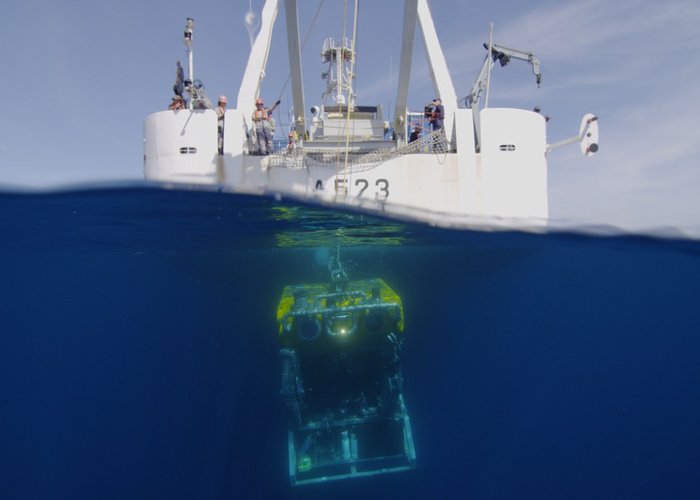
On board the ship “NRP Almirante Gago Coutinho” engaged in the mission of the Portuguese Sea Mapping Project of the Hydrographic Institute, the scientific team dedicated to the study of deep sea ecosystems discovered, through dives with the ROV “PLUS” of the EMECC, a new hydrothermal field.
According to Emanuel Gonçalves, leader of the Blue Ocean Expedition and Administrator of the Blue Ocean Foundation, “this is an extraordinary discovery because this hydrothermal field is the lowest depth than other known in the Mid-Atlantic Dorsal and only 60 miles from Faial Island, which for the scientific community represents a unique, more accessible opportunity to get to know better these ecosystems of which we know very little. This discovery reinforces the unique role of the Azores as a natural laboratory for the study of the ocean.”
Telmo Morato, coordinator of the Blue Ocean expedition team dedicated to deep-sea ecosystems and researchers from IMAR and the University of the Azores, says that “hydrothermal fields are areas where hot fluids often related to Vulcanism, rich in minerals that create the conditions for the development of a unique ecosystem that does not depend on sunlight. The hydrothermal field now discovered consists of multiple chimneys of different heights. Hydrothermal fluids are transparent, slightly warmer than the outside and rich in carbon dioxide. Evidence of bacteria associated with this hydrothermal field was found. This discovery of the Blue Ocean expedition has shown that there is still much to discover in the Portuguese sea, the Azores being a unique region for the study of the deep sea. ”
Most hydrothermal fields are located in border areas of divergent tectonic plates, such as the Mid-Atlantic Dorsal, which separates the western group from the central group of the Azores Archipelago, precisely where the giant submarine hill is located. They are areas of high biological and mineral richness, real oasis hidden in the deep ocean, which are usually found miles deep and hundreds of miles from the coastal zones.
Currently, eight deep hydrothermal fields are known in the Portuguese sea off the Azores: “Lucky Strike” (the first to be discovered in 1992), “Menez Gwen”, “Rainbow”, “Saldanha”, “Ewan”, “Bubbylon”, “Seapress” and “Moytirra”. The scientific studies carried out in them, in which scientists from the IMAR and the University of the Azores have played an important role over the years, represent important contributions to the knowledge of these ecosystems and their associated mineral resources.
About Blue Azores:
With an estimated duration of three years, this partnership between the Blue Ocean Foundation and the Waitt Foundation aims to promote, protect and enhance the blue natural capital of the Azores Archipelago, in close collaboration with the Regional Government of the Azores and other entities. The programme involves many of the areas of activity of the Blue Ocean Foundation: science, conservation, evaluation of the economic value of ecosystems, literacy and co-management of fisheries.
About the Blue Ocean Foundation:
Its genesis results from the conviction that in times of profound change, it is necessary to change behaviors that allow the coexistence of human development with the protection of the ocean. Thus, in 2017, the Foundation was born of a desire to bring Portugal closer to the sea and to help the country develop a blue generation and to position itself as a leader in ocean-related issues.
The Blue Ocean Foundation has the Literacy, Conservation and Training as its main axis of activity, under the motto “from the ocean’s point of view”.
The Blue Ocean expedition is a partnership between:
- Blue Ocean Foundation
- Waitt Foundation
- National Geographic Pristine Seas
It has the collaboration of:
- Regional Government of the Azores
- Hydrographic Institute
- Mission Structure for Continental Platform Extension
And with the following participants:
- University of the Azores
- IMAR
- MARE
- CIBIO
- CCMAR - Centro de Ciências do Mar
- UWA – The University of Western Australia
- University of Hawaii’í
- UCSB – University of California, Santa Barbara
- IEO – Español Institute of Oceanography
- CEAB - Centre d'Estudis Avançats de Blanes
- Museo del Sea Ceuta
Blue Ocean Expedition Discovers New Hydrothermal Field in the Azores

Blue Ocean Expedition Discovers New Hydrothermal Field in the Azores
Blue Ocean Expedition Discovers New Hydrothermal Field in the Azores
208 
2018-06-21